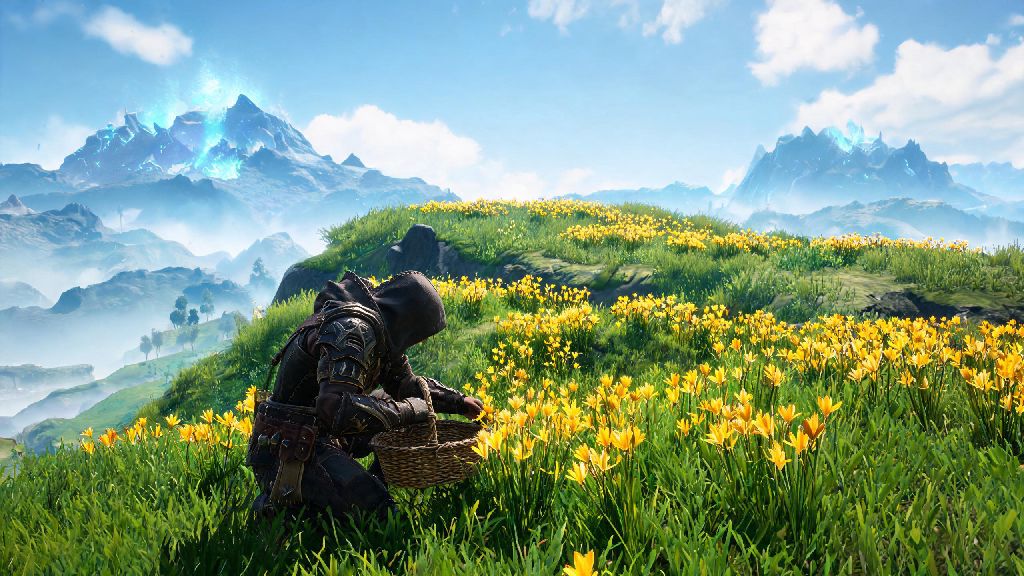
If you’ve spent hours wandering flower patches hunting for this bright, rare herb, you’re not alone. Saffron is one of the most frustrating mid-game resources to track down for new players, and it’s required for some of the most useful upgrades and crafting recipes in the game. I wasted three entire in-game days scouring the Springlands for saffron before I realized it doesn’t spawn in the starting zone at all, so I put together this guide to save you the same headache. If you’re trying to craft stronger healing items or upgrade your Flame Altar to access new biomes, knowing where to find saffron enshrouded will save you hours of unnecessary wandering.
Core Spawn Regions Where You Can Find Saffron in Enshrouded
Saffron only grows in very specific climate and elevation conditions, so you can skip entire sections of the map when you’re hunting for it. It never spawns in the low-lying, shroud-heavy areas or the dry, sandy parts of the map, so stick to elevated, grassy biomes with mild temperatures. The only two biomes you’ll find wild saffron in are Revelwood and the southern edge of the Kindlewastes, so don’t waste time checking any other regions. I usually stick to Revelwood for most of my saffron farming, since the enemies there are far less dangerous for mid-game players who don’t have fully upgraded gear yet.
If you’re looking for consistent, clustered spawns that you can loop for bulk farming, these three spots are the most reliable I’ve found after 80+ hours of play:
All of these spots are within 100 meters of a fast travel point, so you don’t have to run for 10 minutes just to reach the farm route. I usually start at the Western Cliffs, loop north to the plateau, then fast travel back to the Ancient Spire to repeat the route if I need a lot of saffron.
How to Spot Saffron Quickly During Exploration
Even if you’re in the right biome, it’s easy to walk right past saffron if you don’t know what to look for, especially if you’re exploring at dusk or dawn when visibility is low. Saffron has a very distinct look: it has a thin purple stem, small bright orange blooms, and it emits a faint golden glow that’s visible even from a distance. It’s easy to mix it up with wild marigold at first glance, but marigold has a green stem and solid yellow blooms, so you’ll learn to tell the difference quickly after a few harvests.
There are a few small settings tweaks and tricks that will make spotting saffron way faster. First, turn up your flora render distance in your graphics settings to high if your device can handle it. This lets you spot saffron patches from 50+ meters away, instead of only seeing them when you’re 10 meters away. It cuts my farming time almost in half every time I run a route.
You also want to use your survival sense ability every 30 seconds or so when you’re in a known saffron spawn area. Activating survival sense highlights all harvestable resources in bright gold, so you can spot saffron even if it’s hidden behind trees or rocks. One important thing to remember: saffron only grows on uncovered, non-shrouded ground. If the area you’re in is covered in the red shroud fog, you won’t find any saffron there, so stick to cleared, elevated land to save time.
Best Practices for Farming Saffron Efficiently
Once you know the spawn spots, you can farm as much saffron as you need in a very short amount of time if you follow a few simple rules. First, remember that wild saffron respawns every 30 in-game minutes, which is roughly 2 real-time minutes. That means you can loop the three spawn spots we listed earlier nonstop without waiting for respawns, since by the time you finish the third spot, the first spot will already have new saffron spawned.
If you hate traveling back and forth to farm wild resources, you can grow your own saffron at your base once you unlock the Farmer NPC. Every time you harvest wild saffron, you have a 50% chance to get 1 saffron seed alongside the herb itself. Once you have at least 5 seeds, you can plant them in raised garden beds at your base, and they’ll fully mature in 10 in-game minutes. I highly recommend planting them in fertilized soil if you can, since regular soil only gives 1 saffron per harvest, while fertilized soil gives 2 to 3 per plant, which doubles your yield for no extra work.
I also always bring a glider when I’m farming wild saffron, since most of the best spawn spots are on cliff edges. Gliding between the spots lets you skip climbing up and down rocky ledges, which cuts down your travel time between spawns by a huge amount. I used to run the entire route on foot, and it took me 20 minutes to farm 50 saffron. Now with a glider, I can get 50 saffron in 8 minutes flat.
Top Uses for Saffron to Make Your Grind Worth It
A lot of players skip farming saffron when they first get to Revelwood, but it’s one of the most useful mid-game resources you can collect, and you’ll need hundreds of it as you progress through the game. The most common use for saffron is crafting Greater Healing Potions, which require 2 saffron per craft and restore 70% of your max health instantly. These potions are non-negotiable for late-game dungeons like the Black Vault, where regular healing potions don’t restore enough health to keep up with boss damage.
You’ll also need 30 saffron to upgrade your Flame Altar to level 4, which unlocks the ability to clear level 4 shroud zones and access the Kindlewastes biome. If you want to progress the main story, you can’t skip this upgrade, so it’s a good idea to stock up on saffron as soon as you get to Revelwood, instead of scrambling to find 30 of it when you’re ready to upgrade your altar.
Saffron is also used for a lot of popular build-specific gear and base upgrades. Mage builds need it to craft Enchanter’s Robes, which give a 30% boost to all magic damage, and you can use it to craft permanent glow lanterns for your base that don’t need to be refueled like regular torches. I even use saffron to craft advanced food items that give long lasting stamina buffs for long exploration runs.
At the end of the day, knowing where to find saffron enshrouded doesn’t have to be the frustrating guessing game it was for me when I first started playing. Stick to the Revelwood spawn spots we listed, use your survival sense to spot patches fast, and set up a small farm at your base once you unlock the Farmer NPC to eliminate travel time entirely. I still keep a 10-bed saffron farm next to my main base even after beating the main story, since I go through so much of it for dungeon runs with friends. If you have a favorite saffron spawn spot we didn’t mention, feel free to share it in the comments to help other players out.